Import IIF into QuickBooks Desktop: convert IIF to QBO
QuickBooks Desktop imports QBO and IIF files. It can take your IIF file directly, so convert it to QBO when the direct import fails or you need what QBO offers. Read the full QuickBooks Desktop import guide.
What is an IIF file
IIF is a tab-delimited accounting file used by QuickBooks Desktop. Other apps prepare IIF files for import into Desktop, and Desktop can export transactions as IIF. If you have switched to another accounting app, those files may still contain transactions you need. ProperConvert reads the transactions and skips lists such as accounts, customers and vendors, as well as non-posting records such as estimates and purchase orders.
Choose how to read the IIF file
Use Transactions when the transactions belong to one bank or credit card account. ProperConvert reads the date, amount, payee, memo, check number and class; the other account becomes the category. Split transactions keep their splits. Check the account type and review the issues list before converting.
Use General Journal Entries for journal entries or transactions belonging to several accounts. Each accounting line has its own account and debit or credit, and the lines belonging to one transaction form an entry. This is the mode to use for QBJ output. Do not flatten a multi-account journal into bank transactions merely to change its file format.
See Open a QuickBooks IIF file for mode selection, skipped records and the messages that ask you to switch modes.
What is a QBO file
QBO is the Web Connect format that QuickBooks Desktop uses to import bank transactions. It has a fixed structure that QuickBooks expects, with fields for the date, amount, payee, memo, check number and a transaction ID. More about QBO.
Why convert IIF to QBO
An app may have prepared your IIF file for QuickBooks Desktop import, or you may have exported it from Desktop. Convert eligible bank or credit card transactions to QBO when you want to bring them through Bank Feeds for review and matching instead of importing IIF directly into the register.
Read a file for one account in Transactions mode and check its dates and amounts. QBO is a bank-transaction format: it does not recreate the original invoices, bills, journal entries or IIF lists. For balanced journal entries, use General Journal Entries mode and a suitable journal output instead. Check the destination's QBO requirements below before converting.
Before you import: back up QuickBooks
Back up your QuickBooks company file before you import any file, so you can restore it if something comes in wrong. On Windows, click File > Back Up Company > Create Local Backup. On a Mac, click File > Back Up, then Start Backup.
Step by step: convert IIF to QBO
- Install and start the latest ProperConvert.
- Choose Transactions and open your IIF file. Use a file whose transactions belong to one bank or credit card account. If it contains several accounts or the app asks to switch to journal mode, read IIF mode selection before continuing.
- Review the account type, dates, signed amounts, payees and memos. The other side of each IIF transaction becomes its category; check splits and the issues list too. Confirm that the file covers the account and period you intend to import.
- Choose QuickBooks Desktop as the destination where available and select the QBO output. Otherwise choose the matching QBO target for your app. Apply the output settings below, including the account identifiers and any required format variant.
- Click Convert and choose the file name and location. Keep the original IIF file for reference.
- Follow the destination's import steps below. Review the imported transactions, check their count and amounts, and reconcile the account before importing more files. Avoid importing the same period twice.
This workflow transfers account activity. Categories and splits are read from IIF, but what reaches the destination depends on the output and importer; do not assume every accounting detail survives the conversion. For balanced journal entries with their separate accounts, use General Journal Entries and IIF or QBJ instead.
Set the QBO output settings
In the QBO/QFX/OFX tab on the right sidebar, set the file type to QBO, then set:
- Account ID: digits only. Use the same ID for every file of one account and a different ID for each account. The real account number is the easiest choice. See QBO files for multiple accounts.
- Account type: checking, savings or credit card. It must match the account you import into.
- Currency: must be USD for the QuickBooks Desktop US edition, USD or CAD for the Canadian edition.
- INTU.BID: must be a bank label QuickBooks allows for this account type. Click Lookup to pick one, or use any allowed value if your bank isn't listed. See INTU.BID.
QBO has no expense or income account. You assign those in QuickBooks after the import. See all QBO settings and the QBO format.
Import the QBO file into QuickBooks Desktop
QuickBooks imports QBO files only in versions up to about three years old. For an older version, use IIF.
On Windows:
- If the account shows a lightning bolt icon in the Chart of Accounts, it is connected to online banking. Right-click it, choose Edit Account, click Bank Feed Settings, and choose Deactivate All Online Services.
- Click File > Utilities > Import > Web Connect Files and open the QBO file.
- Select Use an existing QuickBooks account, choose the account, and click Continue.
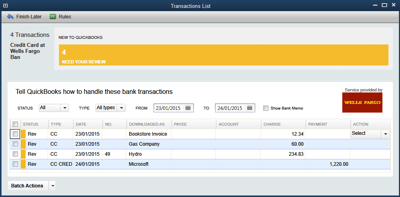
- Open Banking > Bank Feeds > Bank Feeds Center, choose a payee and an expense or income account for each transaction, and click Add/Approve.
On a Mac, turn off the account's online settings, click File > Import > From Web Connect, choose the account, then match each transaction and add it.
Importing the same period twice can create duplicates. If QuickBooks shows an error, see QuickBooks import errors.
QuickBooks Desktop QBO questions
Do I need to match the bank name in the QBO file to my actual bank?
No. The INTU.BID value in the QBO file sets the bank label QuickBooks shows during import. It does not need to match your real bank. If your bank is not in the list, use any allowed value. The transactions will import correctly regardless.
Why does QuickBooks show a yellow icon on my account before importing?
The yellow icon means the account is connected to online banking (direct download). QuickBooks does not allow QBO file imports into a connected account. You need to disconnect the account from online services first, then import the QBO file.
How is a QBO file different from an OFX file?
QBO and OFX use the same base format. QBO files include an extra field (INTU.BID) that QuickBooks uses to identify the bank. For most purposes they are interchangeable, but QuickBooks Desktop expects the QBO variant for Web Connect imports.
Why does QuickBooks say my bank does not support Web Connect?
The bank ID in the QBO file is not one QuickBooks recognizes. A converter sets the bank ID from its own list. Choose a listed bank, or use an ID that QuickBooks accepted before.
Why did QuickBooks create a new account instead of using mine?
The account ID in the file does not match the ID QuickBooks stored for the existing account. Use the same account ID as the last successful import, or connect the file to the existing account when QuickBooks asks.
Why are transactions missing or doubled after import?
QuickBooks skips rows whose transaction ID it has seen before. Missing rows usually mean repeated IDs in the file. Doubled rows usually mean a statement that was already imported with different IDs. Both are fixed by importing each period once, with IDs that stay the same for the same transaction.
Related QuickBooks Desktop conversions
- Import PDF into QuickBooks Desktop: convert PDF to QBO
- QuickBooks Desktop: convert CSV or Excel to QBO
- Import OFX into QuickBooks Desktop: convert OFX to QBO
- Import QFX into QuickBooks Desktop: convert QFX to QBO
- Convert QBO to QBO for QuickBooks Desktop
- Import QIF into QuickBooks Desktop: convert QIF to QBO
- QuickBooks Desktop: convert MT940 to QBO
- QuickBooks Desktop: convert IIF to IIF
- QuickBooks Desktop: convert IIF to QBJ